



Every new year brings renewed focus on growth, efficiency, and resilience. For technology leaders, founders, and product teams, that focus often starts with a fundamental decision: how should our infrastructure scale as the business grows?
Choosing between Infrastructure as a Service (IaaS), Platform as a Service (PaaS), and Software as a Service (SaaS) is not just a technical choice. It is a strategic one that affects cost structure, development velocity, operational complexity, and long-term flexibility.
This guide explains each model clearly, compares them from a scalability perspective, and helps you decide which approach best fits your goals in the year ahead.
Why Scalability Should Drive Your Tech Stack Decision
Scalability is not just about handling more users. It also includes:
- Scaling development teams
- Managing infrastructure complexity
- Controlling operational costs
- Supporting faster releases
- Adapting to changing business needs
A tech stack that scales poorly can turn growth into a liability. Conversely, the right foundation allows your organization to expand smoothly without constant re-architecture.
That is why choosing between IaaS, PaaS, and SaaS deserves careful consideration.
Understanding the Three Models
Before comparing them, it is important to understand what each model actually provides.
What Is IaaS?
Infrastructure as a Service provides raw computing resources over the cloud. This includes:
- Virtual machines
- Storage
- Networking
- Load balancers
- Firewalls
With IaaS, you manage the operating systems, runtime environments, applications, and data. The cloud provider manages the physical hardware.
Scalability Strengths of IaaS
- High control over infrastructure
- Flexible scaling for custom workloads
- Suitable for complex or legacy systems
- Fine-grained optimization for performance
Scalability Trade-offs
- Requires strong DevOps and infrastructure expertise
- Scaling often involves manual planning
- Higher operational overhead
- Longer time to market
IaaS scales well technically, but it scales people and processes more slowly.
What Is PaaS?
Platform as a Service sits between infrastructure and applications. It provides:
- Managed runtimes
- Databases
- Middleware
- Deployment pipelines
- Built-in scaling mechanisms
With PaaS, developers focus on application logic while the platform handles infrastructure concerns.
Scalability Strengths of PaaS
- Faster development and deployment
- Built-in auto-scaling
- Reduced infrastructure management
- Consistent environments across teams
Scalability Trade-offs
- Less control over underlying systems
- Platform limitations can influence architecture
- Risk of vendor lock-in
- Customization may be restricted
PaaS scales teams and velocity extremely well, making it attractive for modern product development.
What Is SaaS?
Software as a Service delivers complete applications over the internet. Users simply configure and use the software.
Examples include CRM systems, analytics tools, collaboration platforms, and accounting software.
Scalability Strengths of SaaS
- Immediate scalability
- No infrastructure management
- Predictable costs
- Rapid onboarding
Scalability Trade-offs
- Limited customization
- Integration constraints
- Dependency on vendor roadmap
- Less control over data and performance
SaaS scales usage effortlessly but offers minimal control over how scaling happens.
IaaS vs PaaS vs SaaS: Scalability Comparison
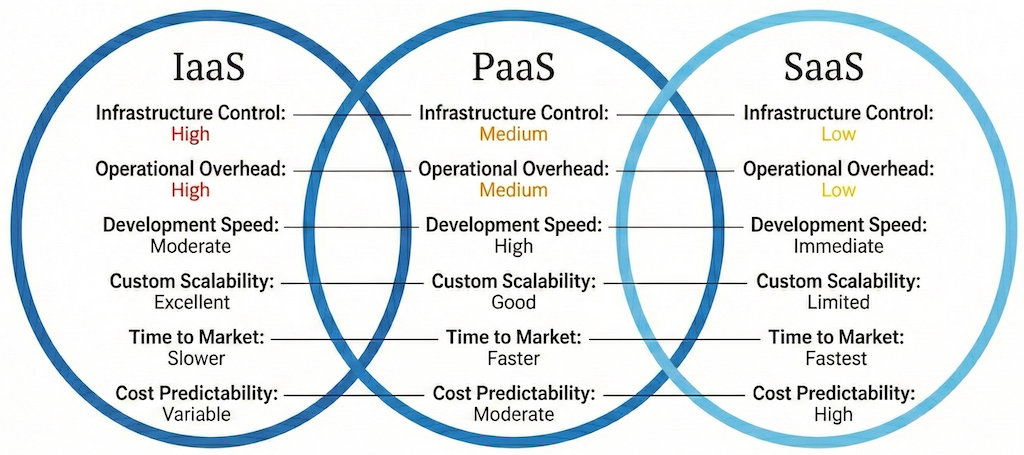
| Dimension | IaaS | PaaS | SaaS |
|---|---|---|---|
| Infrastructure Control | High | Medium | Low |
| Operational Overhead | High | Medium | Low |
| Development Speed | Moderate | High | Immediate |
| Custom Scalability | Excellent | Good | Limited |
| Time to Market | Slower | Faster | Fastest |
| Cost Predictability | Variable | Moderate | High |
This comparison highlights an important truth: scalability is not only technical—it is organizational.
Choosing Based on Business Stage
Early-Stage Startups
For early-stage companies, speed and focus matter more than control.
- SaaS reduces distraction and overhead
- PaaS accelerates product development
- IaaS is rarely necessary at this stage
Most startups benefit from a SaaS-first approach combined with PaaS for core applications.
Scaling Products and Growth-Stage Companies
As teams grow, requirements change.
- PaaS becomes highly attractive
- Auto-scaling supports unpredictable demand
- Development teams move faster with less friction
- Infrastructure complexity remains manageable
At this stage, scalability means supporting people and processes, not just traffic.
Enterprises and Complex Systems
Larger organizations often require deeper control.
- IaaS supports custom architectures
- Legacy systems integrate more easily
- Compliance and security controls are granular
- Hybrid approaches become common
Enterprises often combine all three models across different domains.
A Hybrid Reality: Mixing Models for Scalability
In practice, most scalable architectures are hybrid:
- SaaS for non-core business functions
- PaaS for customer-facing applications
- IaaS for specialized workloads or legacy systems
This layered approach balances speed, cost, and control without forcing a single model everywhere.
Key Questions to Ask Before Choosing
Before committing to a tech stack for the new year, ask:
- How fast do we need to ship?
- How much control do we actually need?
- What skills does our team have today?
- How predictable is our growth?
- Where do we expect complexity to increase?
Clear answers to these questions often reveal the best model naturally.
Common Mistakes to Avoid
- Choosing IaaS “for flexibility” without DevOps maturity
- Overusing SaaS for core product logic
- Ignoring vendor lock-in risks
- Optimizing for today instead of next year
- Treating scalability as only a technical problem
Avoiding these mistakes can save months of rework and significant cost.
Looking Ahead: Scalability as a Strategy
Scalability in the new year is not about chasing trends. It is about aligning technology choices with business reality.
IaaS offers power and control.
PaaS offers speed and efficiency.
SaaS offers simplicity and focus.
The best choice depends on where you are, where you are going, and how you plan to get there.
Conclusion
Choosing between IaaS, PaaS, and SaaS is a strategic decision that shapes how your organization grows. Each model scales differently—not just in infrastructure, but in people, processes, and outcomes.
As you plan for the new year, prioritize clarity over habit and strategy over convenience. A well-chosen tech stack does more than scale systems. It scales your ability to deliver value.