



As companies move closer to 2026, many leadership teams are reassessing their growth strategies. However, despite increased investment and effort, results often fall short. In most cases, the problem is not a lack of activity but rather a lack of clarity. Specifically, branding, marketing, and advertising are still being treated as interchangeable concepts.
As a result, budgets get misallocated, messaging becomes inconsistent, and growth remains reactive instead of strategic. Therefore, understanding the difference between these three disciplines is no longer optional. Instead, it is essential for sustainable growth.
This article explains the distinctions clearly and, more importantly, shows how to define your 2026 growth pillars with intention.
Why This Distinction Matters More Than Ever in 2026
First of all, markets are more competitive than ever. At the same time, customers are more informed, more selective, and less loyal to brands that lack authenticity. Consequently, visibility alone no longer drives growth.
Moreover, digital channels are saturated. As a result, companies that rely only on paid exposure struggle to stand out. Therefore, organizations must shift from short-term tactics to long-term systems.
In other words, growth in 2026 will favor businesses that build trust first, create clarity second, and scale intentionally third. This is precisely why the distinction between branding, marketing, and advertising matters.
What Branding Really Is
To begin with, branding is not your logo, color palette, or tagline. Although those elements matter, they are only surface-level expressions. In reality, branding is the strategic foundation of your business.
More specifically, branding defines how your company is perceived over time. It answers fundamental questions such as:
- Who are we, and why do we exist?
- What do we stand for?
- Why should customers trust us?
- How are we meaningfully different?
As a result, branding shapes expectations long before a customer interacts with your product or service.
Why Branding Is a Long-Term Asset
Unlike campaigns, branding does not expire. Instead, it compounds. Over time, a strong brand reduces friction across every growth channel.
For example, strong branding lowers acquisition costs, increases customer loyalty, and enables premium pricing. Furthermore, it attracts better talent and stronger partnerships.
Therefore, in 2026, branding will not be a “nice to have.” On the contrary, it will be a decisive competitive advantage.
What Marketing Actually Does
Once branding is clearly defined, marketing comes into play. Essentially, marketing is the system that connects your brand to the right audience.
While branding defines who you are, marketing determines how, when, and where that message reaches people. Consequently, marketing transforms strategy into action.
Marketing typically includes:
- Market research and audience segmentation
- Content creation and distribution
- SEO and organic growth initiatives
- Email and lifecycle campaigns
- Social media engagement
- Lead nurturing and conversion systems
As a result, marketing creates demand in a structured and measurable way.
Why Marketing Must Remain Adaptive
Unlike branding, which evolves slowly, marketing must adapt continuously. For instance, it responds to customer behavior, platform changes, and market trends.
Additionally, as buyer journeys become more complex, marketing must focus less on volume and more on relevance. Therefore, personalization, consistency, and value-driven messaging will define successful marketing in 2026.
What Advertising Is — and What It Is Not
At this point, it is important to clarify advertising’s role. Advertising is not a strategy by itself. Instead, it is a tactical lever within a broader system.
Specifically, advertising focuses on paid visibility and short-term amplification. This includes search ads, social ads, display campaigns, and sponsorships.
However, advertising does not create meaning. Nor does it build trust on its own. Instead, it amplifies whatever already exists.
Why Advertising Depends on the Other Two
When branding is weak, advertising feels generic. Likewise, when marketing lacks clarity, ads fail to convert. As a result, companies end up spending more for diminishing returns.
Therefore, in 2026, advertising must support proven strategies rather than compensate for missing foundations.
Branding vs. Marketing vs. Advertising: A Clear Comparison
To summarize the differences clearly:
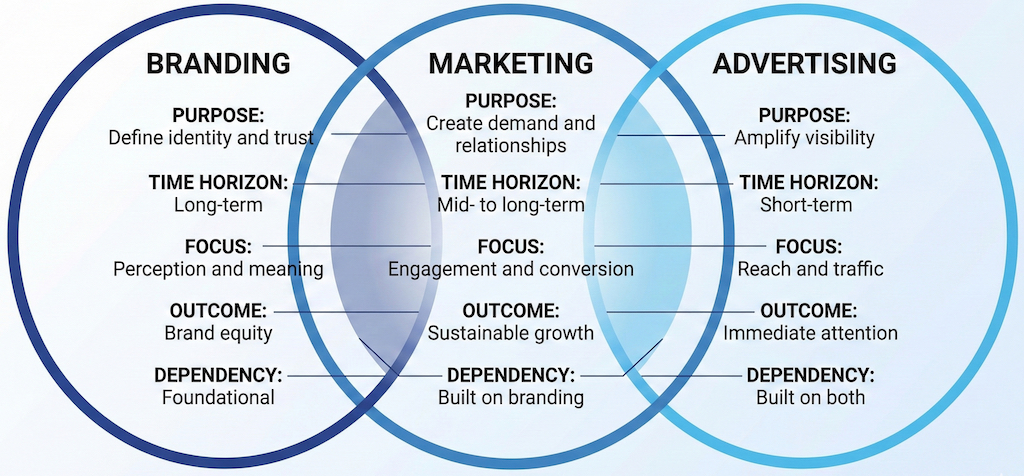
As shown above, each discipline serves a distinct role. Therefore, none should replace the others.
Defining Your 2026 Growth Pillars
Instead of choosing between branding, marketing, and advertising, successful companies treat them as interconnected pillars.
Pillar 1: Branding as the Strategic Anchor
First and foremost, branding should guide every decision. Without it, growth efforts lack direction.
Specifically, branding should define positioning, values, voice, and customer experience. Consequently, every team operates with shared clarity.
Pillar 2: Marketing as the Growth Engine
Next, marketing operationalizes the brand. In other words, it turns identity into demand.
Through consistent messaging and structured systems, marketing educates the market, builds trust, and supports long-term revenue growth. As a result, growth becomes predictable rather than reactive.
Pillar 3: Advertising as the Accelerator
Finally, advertising accelerates what already works. When used strategically, it supports launches, scales validated channels, and expands reach.
However, when used incorrectly, it only increases waste. Therefore, advertising must follow insight—not instinct.
Common Mistakes to Avoid in 2026
Despite best intentions, many companies repeat the same mistakes. For example, they rely on ads without clear positioning. Similarly, they run campaigns without aligned messaging.
Additionally, many teams focus only on short-term metrics while ignoring long-term brand equity. As a result, growth stalls once spending stops.
To avoid this, leadership must align around a shared framework.
How to Align Teams Around These Pillars
Alignment starts with clarity. First, branding sets the direction. Then, marketing executes the strategy. Finally, advertising amplifies proven efforts.
When teams understand their role within this system, collaboration improves. Consequently, growth becomes more efficient and sustainable.
Conclusion: Build for 2026, Not Just the Next Campaign
In conclusion, branding, marketing, and advertising are not interchangeable. Instead, they are complementary systems that must work together.
Companies that define these pillars clearly will spend smarter, build trust faster, and scale with confidence. Ultimately, growth in 2026 will belong to businesses that focus on foundations first and amplification second.
Growth is not about doing more.
Rather, it is about doing the right things, in the right order, with long-term intent.